Los Angeles flight departure
Station ElevenThe Los Angeles flight departure is a turning point in the stranded passengers’ life at Severn City Airport: an improvised escape from isolation that makes flight possible again, but offers no assurance of safety or reunion. As the plane lifts away, Clark sees an ordinary feature of the old world become extraordinary, while the passengers who remain must live with the uncertainty of having let it go.
Background and the offer
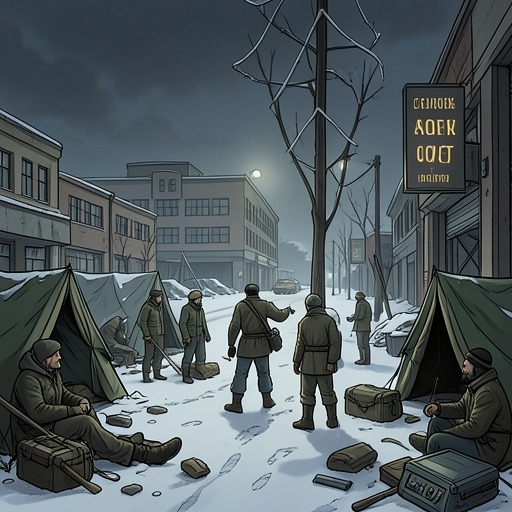
On the twelfth day at the airport, the lights went out. The stranded people adapted to the loss of electricity by collecting snow in plastic trays from the security checkpoints, melting it to flush the toilets, and living by daylight until sundown. The televisions showed silent test patterns, cutting off the news that might have helped them judge what was happening beyond the airport. Three pilots were among the people there, but for several days their presence offered no clear way out.
On the fifteenth day, one of the pilots announced that he intended to fly to Los Angeles. The snow had melted, and he thought he might manage without de-icing machines. The plan was risky: the news from Los Angeles had been grim, and the people at the airport had no reliable information about the outside world. The pilot’s family was there, however, and he was unwilling to accept that he might never see them again. He offered the stranded passengers free seats, a startling departure from the familiar economy of paid extras and reserved privileges.
The plane was fuelled. The pilot explained that he had been flying from Boston to San Diego when the aircraft was diverted, and that the flight would not be full. He gave the passengers a day to decide, saying he would leave the next day before the temperature fell again. His timetable made the choice urgent: waiting meant losing a rare opportunity, but boarding meant entrusting their lives to a journey whose destination might be no safer than the place they were leaving.
The passengers’ decision
By then, seventy-nine people remained at the airport. With no news after the televisions went dark, they could not know whether Los Angeles was intact, whether the aircraft could land, or whether the passengers would find anyone alive there. The uncertainty was not an abstract calculation. For people separated from families and homes by the collapse of ordinary transport, even an uncertain flight could bring them closer to someone they loved.
The passengers weighed that hope against the possibility of disaster. Almost everyone who lived west of the Rocky Mountains approached the pilot, and most of the people from Asia chose to go as well. For them, the flight would still leave an ocean between them and their loved ones, but it would carry them two thousand miles nearer home. Others decided against leaving. The departure therefore divided the airport community between those willing to risk movement and those who judged that staying was preferable to an unknown journey.
Departure
At noon the next day, the passengers boarded by a wheeled staircase found in a hangar. Those remaining gathered on the tarmac to watch. The engines sounded startling after the airport’s days of silence. The plane worked its way out of a line of parked aircraft through a series of careful turns, leaving a space between the Cathay Pacific and Lufthansa jets, then curved toward the runway. Someone in a window waved, too far away for the watchers to identify; a few waved back.
The plane accelerated and rose. Clark held his breath with the others through the moment when it might fail to lift, then realized he had tears on his face. He had travelled frequently before the collapse without recognizing the improbability of flight: a machine carrying people away from the ground and into the open sky. The scene reverses the old habit of looking down from an airplane at distant towns and their lights. In the silent, grounded world around him, the departing aircraft makes movement itself visible as a fragile achievement.
Those who remain
After the departure, fifty-four people remained at the airport. That night they gathered around a fire and ate tough venison in silence. Tyler stood close to Elizabeth and watched the flames. Elizabeth shivered and spoke of hoping that things would return to normal; Clark, unable to answer, glanced at his watch and counted the hours since the plane had left.
He could imagine several incompatible outcomes. The passengers might land in Los Angeles and step into a different world, find their families, or encounter danger; the plane might have to land short of California or crash. The people at the airport had no way to know whether Los Angeles still had electricity, or what had become of a city Clark remembered through scenes from his former life: Miranda at a dinner party, Arthur by a pool, and Elizabeth pregnant beside him. The flight had carried people away, but its outcome remained beyond the reach of those left behind. Its departure offered no resolution, only the spectacle of an aircraft receding into a sky that had once seemed routine.